Separate is Never Equal & Can I Touch Your Hair?

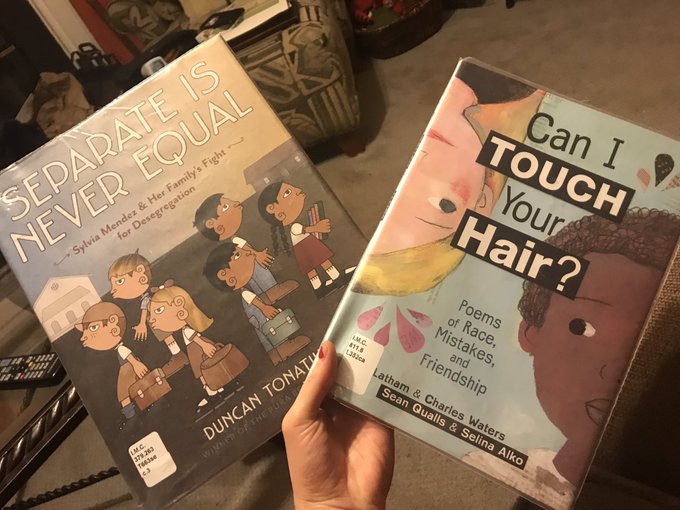
Separate Is Never Equal by Duncan Tonatiuh

Separate is Never Equal: Slyvia Mendez & Her Family’s Fight for Desegregation is about the Mendez vs. Westminster School District trial, in which Mandez’s family argued that their children had a right to go to Westminster School. Slyvia was told that she had to go to the “Mexican School”, which had fewer resources, no playground, and outdated/tattered books. Ultimately, Mandez’s family was sided with, even after an appeal by the school district. You can read more about the case here: https://www.uscourts.gov/educational-resources/educational-activities/background-mendez-v-westminster-re-enactment

There are two pictures from this book that I would like to point out. First, the picture on page 13 (created by the author, Duncan Tonatiuh).
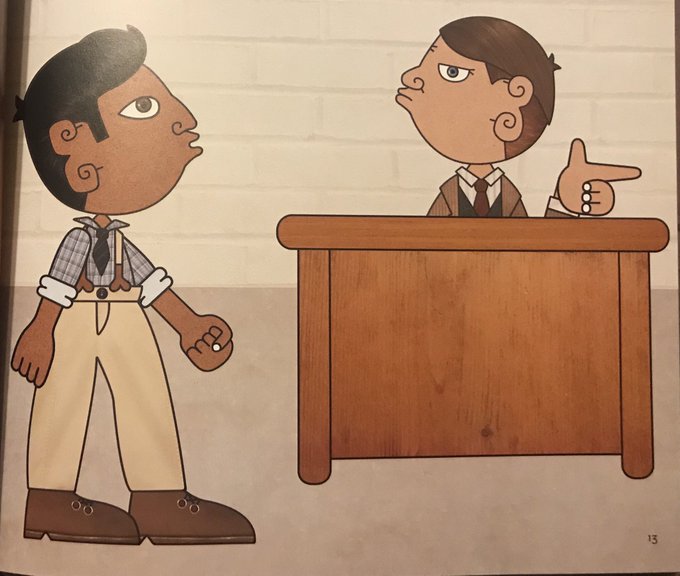
In this photo, Mr. Mandez can be seen talking with a school representative. The person behind the desk has a scowl on his face and he does not look like he is happy talking with Mr. Mendez. He tells Mr. Mendez that his children must go to the “Mexican School”, but offers no explanation as to why. This is racism because the school representative views Mr. Mendez’s children as inferior because they are Hispanic, and he is discriminating against them by forcing them to attend a school that is not as “good” as Westminster. Mr. Mendez combats this racism because, although he is told his children must attend the other school, he continues to fight for their right to attend Westminster. He tries to get others to sign a petition, but he eventually takes his case to court. I love this illustration because Mr. Mendez’s left hand is clenched in a fist, showing that he still has power.
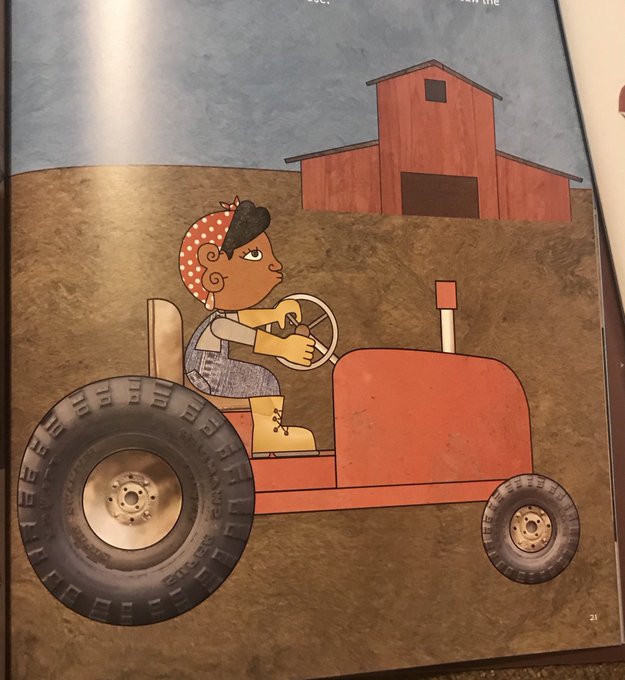
The photo above comes from page 21. Mrs. Mendez can be seen on a tractor. While Mr. Mendez was working on getting his children into Westminster, she was at home taking care of their family farm. In addition, she got her kids ready for school and continued to take care of them everyday. I think that this illustration shows Mrs. Mendez in power because she is shown as a strong women who can handle taking care of her kids and working on the land. She is in overalls and work boots, and she is also operating machinery. She is combating the job stereotype of “maid” or “nanny”, as is often seen in movies (such as The Pacifier (2005), Maid In Manhattan (2002), and The Nanny (1993-1999) ).
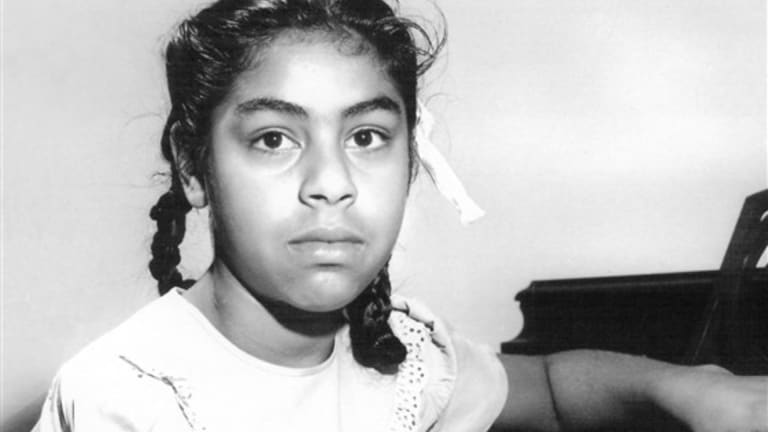
Above is a picture of Sylvia Mendez from 1947. Retrieved from: https://www.uscourts.gov/educational-resources/educational-activities/background-mendez-v-westminster-re-enactment

Tonatiuh, D. (2014). Separate is Never Equal: Sylvia Mendez & Her Family’s Fight for Desegregation. New York, NY: ABRAMS Books.

Can I Touch Your Hair by Irene Latham & Charles Waters

This book, full of insightful poems, paints two different perspectives: those of an African American boy and a Caucasian girl.
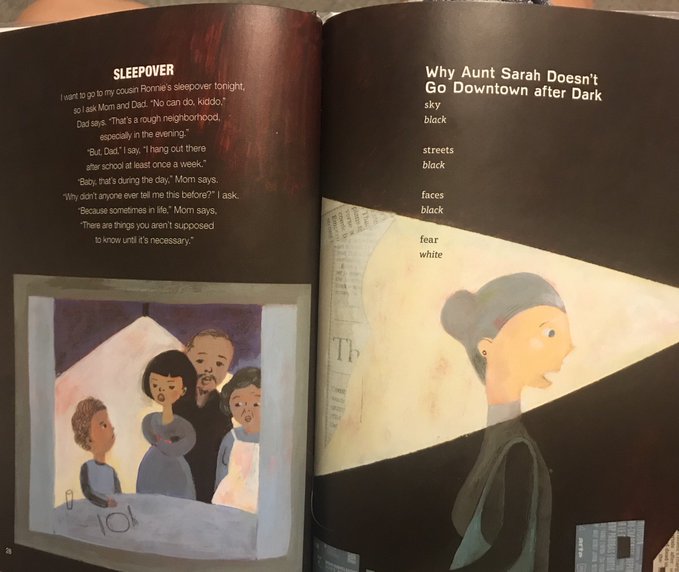
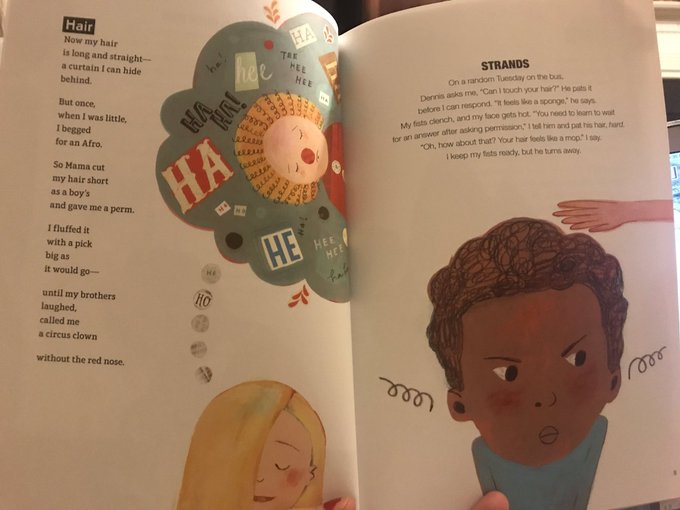
The book starts with poems from each character, explaining their feelings about being partners for a writing assignment at school. Later, the two children show their differing viewpoints on topics such as hair, church, the beach, and dinner with their families.

Latham and Waters do a great job of showcasing the characters’ points of view. Something that makes topics such as these more personal.

Poetry has always been so powerful and profound, in my opinion. Therefore, it seems only right that difficult conversations, such as stereotypes and judgement (see “Strands” on page 9 and “Why Aunt Sarah Doesn’t Go Downtown After Dark” on page 29, my two personal favorites.) can happen as a result of this genre of literature.

The illustrators, Sean Qualls and Selina Aiko, used acrylic paint, collage, and colored pencils to create the beautiful illustrations. I especially liked how the facial expressions on the various characters (like the two children, “Ghost” aka Paul, and the teacher) were created to reflect their feelings at that given time. These illustrators have such talent!

The poems, told from a child’s perspective, could be really powerful to share with other children. In doing so, children may begin to second guess, or think twice, before they participate in certain actions (like saying, “Can I touch your hair?”). Children are never too young to start learning how to treat all people like people.

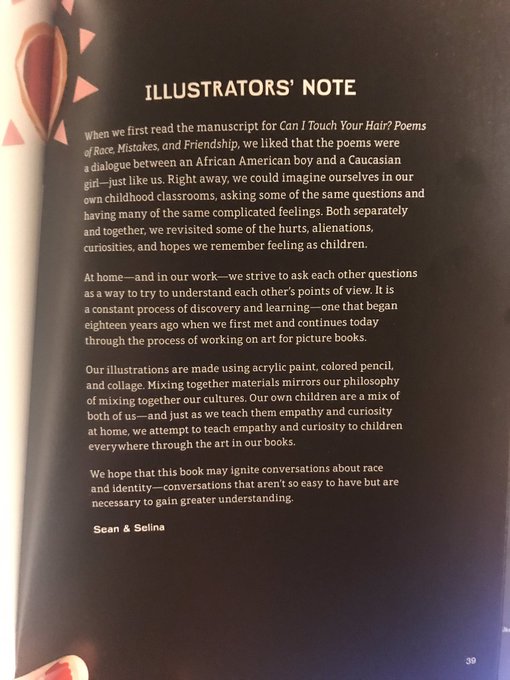
I thought the authors’ and illustrators’ notes were very perceptive. I took a picture of them and will insert them below.
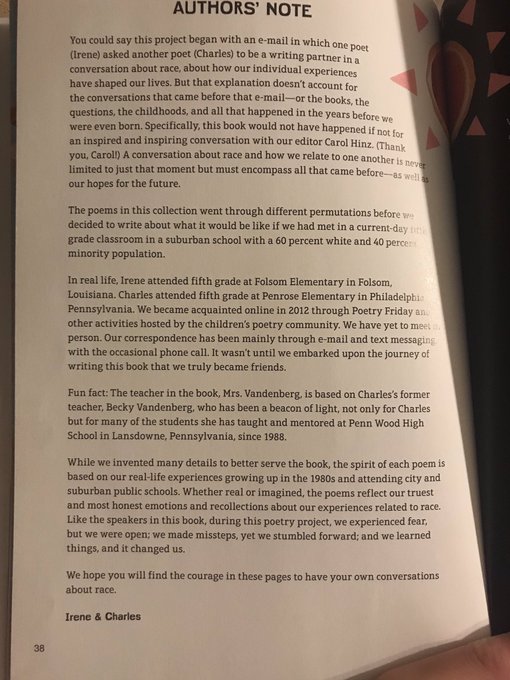
Authors’ Note by Irene & Charles
Illustrators’ Note by Sean and Selina

Latham, I. & Waters, C. (2018). Can I Touch Your Hair? : Poems of Race, Mistakes, and Friendship. Minneapolis, MN: Carolrhoda Books.
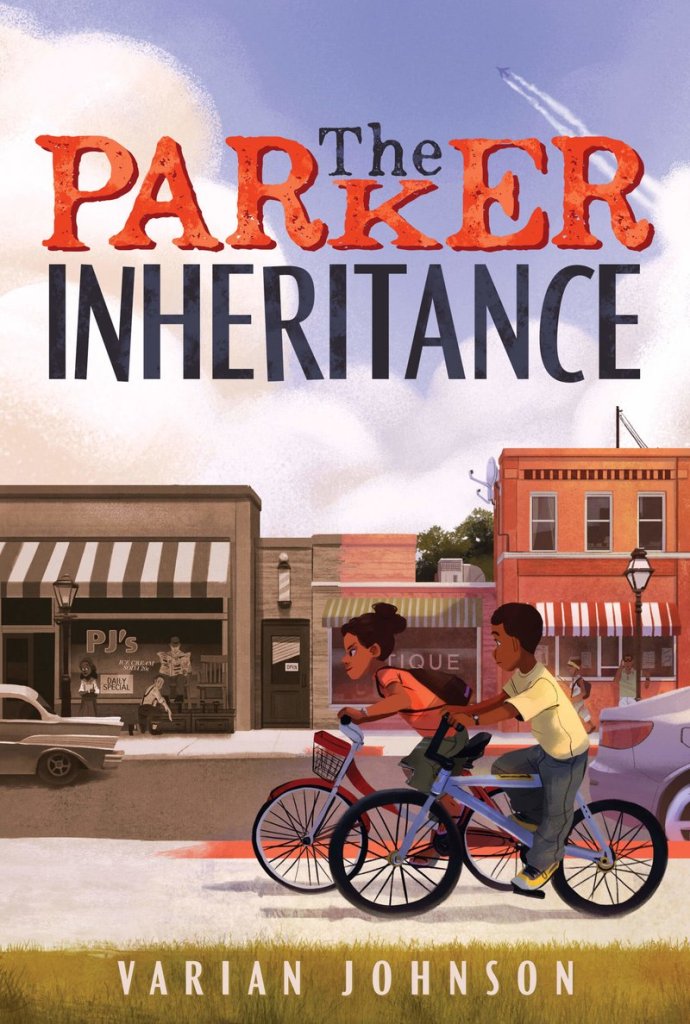
The Parker Inheritance

This particular young children’s book grapples with the theme of justice vs. vengeance. The characters are tested during various social situations that address sexual identity, divorce, racial inequalities, and age discrimination.

This book weaves in topics that are not usually prevalent in children’s books. Because of this, this book would be another one that would lead to important conversations of inclusion in the classroom.

The author, Varian Johnson, experienced racial profiling first-hand when he was just a boy. He was meeting his twin brother at the airport. An undercover police officer ended up searching their vehicle, and bags, because he said he “suspected” them to be drug dealers based on their unconvincing hug. Ultimately, the search came up empty and the police officer went along his way, not offering up an apology. You can read more about this encounter here: http://varianjohnson.com/books/the-parker-inheritance/story-behind-parker-inheritance/

Unfortunately, there are still some questionable police encounters that occur today. Most recently, the Amber Guyger case. If you’re unfamiliar, she is a, now, ex-cop who shot an unarmed black man in his own apartment. She claimed that she thought she was in her own apartment and therefore it must be self defense… right?

Well, one of the star witnesses of this case, one who testified against Amber Guyger, has now been killed as well, also in his home. This happened just ten days after he testified in court in the Guyger trail. Police have made no comments about whether or not his death is linked to his testimony, but we can all agree that it’s a little suspicious. If you are interested, you can click this link and read some more about this incident: https://www.cnn.com/2019/10/05/us/botham-jean-neighbor-killed/index.html

The case of Sandra Bland is another controversial one. She was arrested at a traffic stop and later she was found hanged in her cell. Ultimately, her death was ruled a suicide. However, some of the public had questions. The article here: https://www.nytimes.com/2019/05/07/us/sandra-bland-video-brian-encinia.html, further explains the story and brings attention to how African Americans are sometimes treated by white police officers.

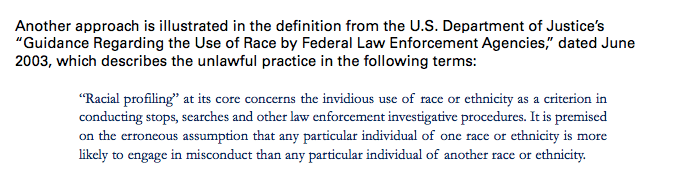
Below is a picture of an excerpt from a leadership guide for police officers. It addresses racial profiling and how a race or ethnicity should not determine whether or not a cop performs/follows certain procedures.

https://www.theiacp.org/sites/default/files/all/p-r/PCR_LdrshpGde_Part3.pdf

In The Parker Inheritance, Candice and Brandon are racially profiled in the high school. They were conducting some research in the memorial room. Upon walking out, they ran into the principal of the school, who was unmoving in his adamant nature that they were stealing. Like the undercover cop from Varian Johnson’s own story, the principal did not apologize when he realized that he was wrong, he only explained that it was a misunderstanding. Tori, another character in the story, is constantly worried about being racially profiled by a police officer while she is driving. She always drives under the speed limit, has both of her hands on the steering wheel, and she is constantly facing forward. She doesn’t want to give a cop any reason to pull her over.

As a white citizen, this made me think a lot about privilege. I drive with one hand on the wheel, I talk on the phone while I’m driving, and I usually set my cruise control to 5 mph over the limit, knowing that 5 mph over will not get me pulled for speeding.

Not only does this book make you think about white privilege, but also privilege that comes with being straight, privilege that comes with being male, and also privilege that comes with having money. This book is a gold mine of minorities. Therefore, it is a great book to have available to your students, or even a book that you could consider having as a read aloud. According to Boyd et al. (2015), if students do not see themselves in literature, they may believe that their lives/stories are not important enough to be portrayed in books. Since this book addresses many topics that are not typically in children’s literature (racial inequalities, sexual identity, poverty), some of your students who may be experiencing these challenges may be able to somewhat identify with the characters in this book.

“The state of literature for young readers in terms of cultural diversity today has both pros and cons. One con
is that

—although gains have been made—

there are still not enough books being published that are outside of the white, middle- class, heterosexual world. To educate all children appropriately, teachers need more books that depict diverse lifestyles, opportunities, beliefs, choices, and worldviews in addition to books that focus on the
status quo. ” – Boyd et all, 2015.

Authenticity: this book avoids stereotypes- in fact, it addresses/mentions stereotypes. (ex: in the chapter where Candice and Brandon are stopped by the principal)

Evaluating Diverse Literature

Visual/Verbal Sensitivity: the “n” word being discussed in the book might be too much for some readers

Ideologies: racial profiling is an ideology that is prevalent in this book, Tori driving slow and super focussed is in order to prevent an occurrence of how she believes the world works

To wrap up this blogpost, I want to leave you with my favorite quote/ question from The Parker Inheritance. It is one that will leave you thinking about your own experiences, or thinking about how lucky you are to not have to think about your own experiences when faced with this question.

“How did it feel to listen to things like that every day, knowing the people you worked with thought horrible things about who you really were?”

-The Parker Inheritance, Page 309

Johnson, V. (2018.) The Parker Inheritance. New York, NY: Arthur A. Levine Books, an imprint of Scholastic Inc.

Boyd, F., Causey, L., & Galda, L. (2015.) Culturally Diverse Literature: Enriching Variety in an Era of Common Core State Standards. “The Reading Teacher”, Volume 68, Issue 5. (p. 378-387) Print.

Persona Poems & How to Use Them

Based off of a book I read last week, A Crack In the Sea, I wrote a persona poem from the perspective of Pip, one of the main characters. Pip is the brother of Kinchen, who lives on the Island. The Raft King takes him to Raftworld, where he convinces him to chat with the fish in search of the portal to the First World.  Pip has never really been away from Kinchen before. The poem I wrote reads:

I am gifted and confused.

I lived on the island, but I think I’ll stay in Raftworld, where we float on top of the water.

I wonder why I can’t remember faces.

I hear Kinchen “coming to my rescue”.

I see a bunch of people I don’t recognize.

I want to be independent.

I am as curious as a cat.

I am gifted, confused, curious, and young.

I question the Raft King and his intentions for looking for the First World.

I feel suspicious.

I taste water.

I worry that the Raft King will take his people to the First World without their consent.

I excel at talking to fish.

I understand that I was brought to Raftworld to find the portal.

I am gifted, confused, worried, and suspicious.

I say the Raft King is selfish.

I believe his people should get to vote.

I dream I will make a difference.

I try to speak up.

I hope it helps.

I was once afraid;

But now I am more confident.

I am Pip.

Books such as this one, and Freedom Over Me: Eleven Slaves, Their Lives and Dreams Brought To Life, are great books to use to write persona poems. Their characters are explained and described in detail that would allow for students to think about their individual points of view. The goal of the persona poem is to think about point of view. For more information about persona poems and how to use them click here: https://www.writersdigest.com/whats-new/the-many-faces-of-persona-poems

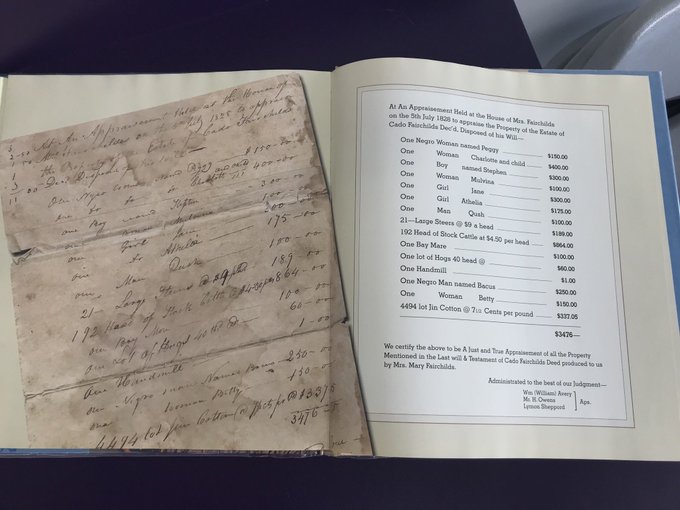
Freedom Over Me is a picture book that has won the Coretta Scott King Award three times. Ashley Bryan found some old slave documents in his possession, and he used them to write this book, more specifically, he used the Fairchilds’ Appraisement document from 1828.

The real document is on the left, and the document written in clear English is on the right.

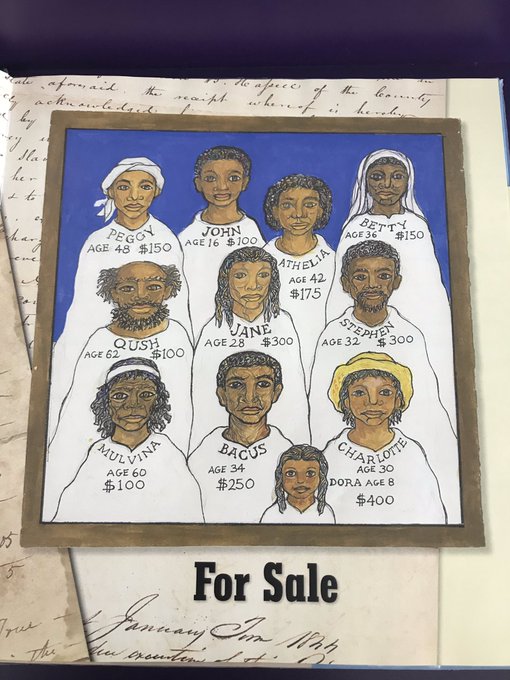
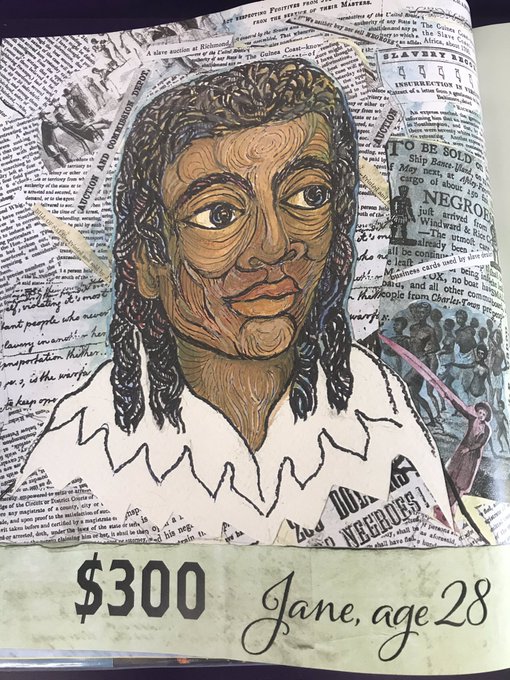
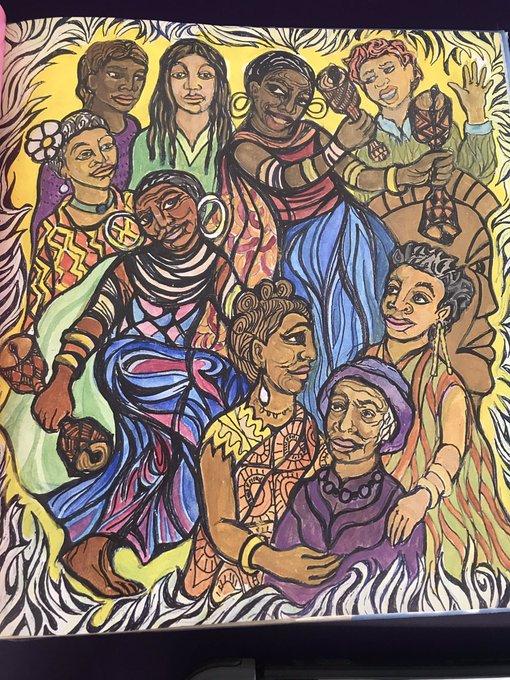
On the document, eleven slaves were listed for sale. He wrote about each individual slave in a way that allowed to “tell their stories”. One page shows a headshot of the slave, their listed “value”, and a description of their duties and relationships to some other slaves. On the page following, Bryan writes about their dreams and showcases a picture that is generally more colorful and happy than the headshot on the previous page. Since the author provides background details, and the character’s dreams, this book would be a good book to write persona poems from with your class. There are eleven different characters to write about.

This picture from the book shows the 11 slaves and their listed “values”.

This book is great because it doesn’t simply say, “there were slaves and they were worth this much and slavery is bad.” Bryan gave each slave a voice, a background story, and a description of their hopes and dreams.

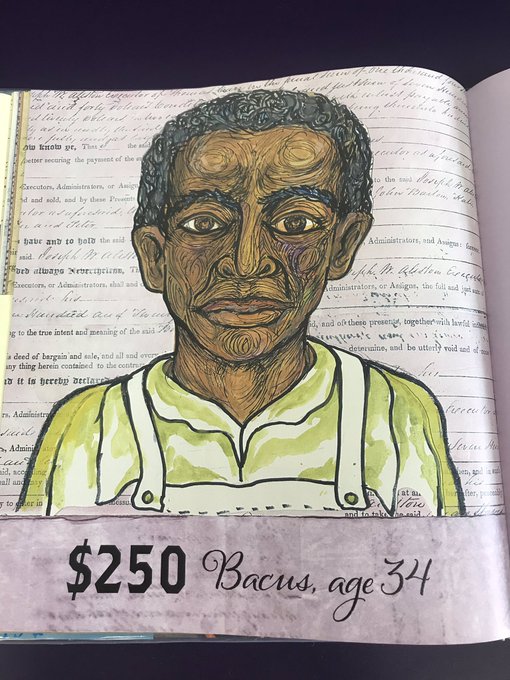
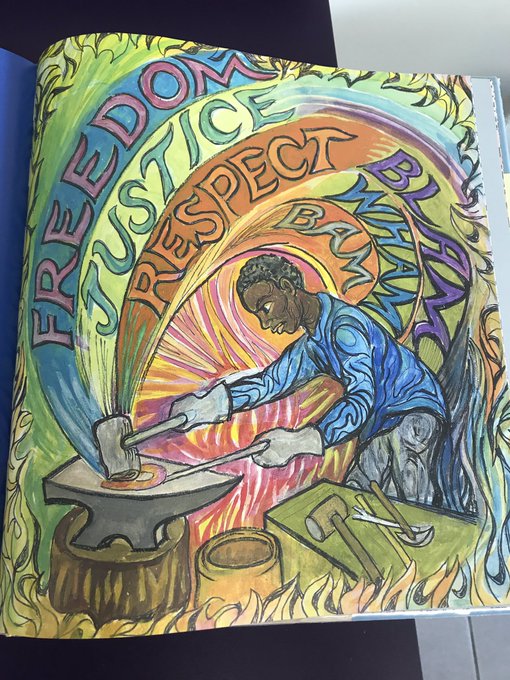
For example: Below, this is Bacus. He is 34 years old and was appraised at $250. In his background story, it says he has a wife and a daughter. He was apprenticed to a blacksmith and he makes metal objects and parts for the Fairchilds’ estate. He is afraid of being separated from his wife and child since they are being appraised. The following page tells of how he used his work as an outlet. With every pound of his hammer, he is ridding himself of anger. He wants justice, respect, and freedom.

This book shows the slaves as not just slaves. Slavery was more complex than our textbooks sometimes make it seem. This book shows slaves as people; people with feelings and dreams.

Bryan, A. (2016). Freedom Over Me: 11 Slaves, Their Lives and Dreams Brought to Life. New York, NY: Simon & Schuster.

In “Discussing Racial Trauma Using Visual Thinking Strategies”, Gardner talks of how art and storytelling can serve as tools to teach about racism. Additionally, how they can serve as a form of healing for racially diverse people within the school setting (Gardner, 2017). This is yet another reason to have this book in your classroom library. This book is a clear example of racism, and, in addition to teaching about racism, this book can serve as a healing tool for some of your students. Through the writing of persona poems, based off of this book, students can start a healing process, and one that you, as a teacher, have the power to foster.

Bryan’s book allows the opportunity for students to ask questions and express emotions, which can prevent students from feeling a crisis in their identity (Garner, 2017). Your classroom can have great discussions centered around this book, just make sure you have had conversations about respect and tolerance first.

Garner, R. (2017). Discussing Racial Trauma Using Visual Thinking Strategies. Language Arts, Volume 94 (issue 5), pp. 338-345.

Becoming Familiar in an Unfamiliar Place

Yuyi Morales beautifully writes and illustrates her book, “Dreamers”. The pictures are composed of mixed media, acrylics, ink, and paper are used.

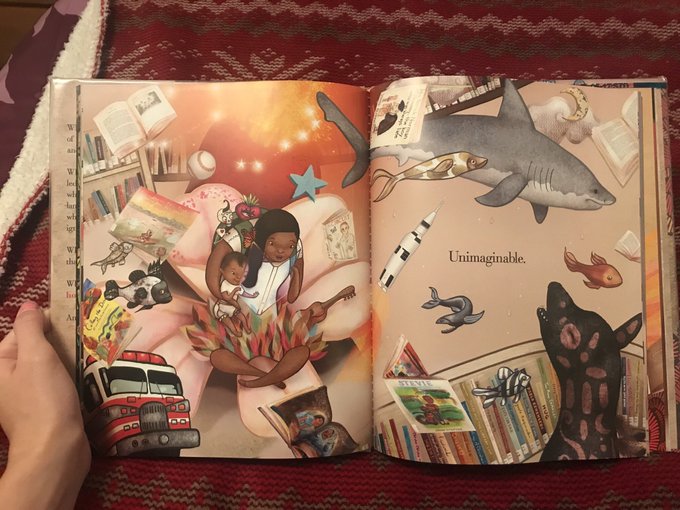
“Unimaginable”

I love this spread above, because Yuyi writes about the power of the library in the back of the book on a page titled “My Story”. Yuyi is an #ownvoices author. She came to America with her son, where she married her husband, a U.S. citizen. She talks about becoming an immigrant and how the library was a wonderful place for her and her son. The library gave them hope, security, and freedom. They were able to take books off the shelves without being reprimanded, and they were able to discover picture books. The spread above shows the limitless stories that they were able to read in the safety of the public library. The stories are coming to life. The library helped Yuyi, and her son, become familiar in an unfamiliar place.

A nice added touch to this book, is the list of other books in the back. Yuyi alphabetized a list of books that “inspired her”. Not only are the titles listed, but she also wrote their publication information. I can only wonder if these are books that she came across in the public library with her son when she first came to America.

Morales, Y. (2018). Dreamers. Toppan Leefung, Dong Guan City, China : Neal Porter Books.

__________________________________________

For older children, H.M. Bouwman’s “A Crack in the Sea”, tells of a story with a similar theme. This story tells of multiple characters who try to navigate a new place. Personally, I was not excited to read this book at first. I felt that it had a slow start and I was confused by the story line, thinking I needed more information, which I did not. About page 36, is when the book started to peak my interest, which it held for the remainder of the story.

This story is unlike anything I have ever read before, and I think that is why I enjoyed it.

There are a lot of characters, but the idea of two separate worlds and how to navigate between them is interesting. I have seen this theory played with in T.V. shows (such as Stranger Things on Netflix) and in Movies (such as the Matrix). However, I have never seen this theory present in a children’s novel.

While I would consider this book to be fiction, I do admire the author for tying in some real-life events and characters.

For example, a character named Amelia flies away and doesn’t return. This character is linked to the famous Amelia Earhart to flew over the Bermuda Triangle and disappeared.

The author also writes Venus’ story, in which she is on an overcrowded boat with other people who were viewed as less than human. Lots of them were sick or dying. She talks of the long travel to another land and the horrific conditions of the boat. Upon realizing how many people were dying, the boat captain and his crew began throwing people overboard, because insurance would cover the loss of captives if they were “lost at sea”. This event in the story was an actual event in real life. It is called the Zong Massacre. You can read more about it here: https://www.blackpast.org/global-african-history/zong-massacre-1781/ (I encourage you to read about it because this event is not something that is discussed in schools, that I am aware of. Although slavery is, and the Middle Passage is, and the Atlantic Slave Trade is, this particular event was something that I was ignorant to before reading this book.)

The mentioning of the Zong Massacre is used in the book to explain the gifts of Venus and how she can walk along the ocean’s floor. She leads her people to safety and they must learn how to survive in an unfamiliar place. Their experiences and determination make themselves “familiar”. The same thing goes for Thanh and Sang, who find themselves in the second world. When deciding to stay, they are forced to make this new place their home. They must become familiar in a once unfamiliar place.

Bouwman, H.M. (2017). A Crack In the Sea. New York, NY: G.P. Putnam’s Sons.

Judgement: A Text Set

The following books are included in this text set:

  • “Red: A Crayon’s Story” by Michael Hall
  • “Last Stop on Market Street” by Matt De La Pena
  • “Rescue and Jessica: A Life Changing Friendship” by Jessica Kensky and Patrick Downes

Upon reading all three of these books I found myself identifying “judgment” as a commonality. Not necessarily that judgement was the theme, but that these books would be excellent to use when teaching in the classroom if you wanted to address judgment (which, let’s be honest, you should).

Red: A Crayon’s Story

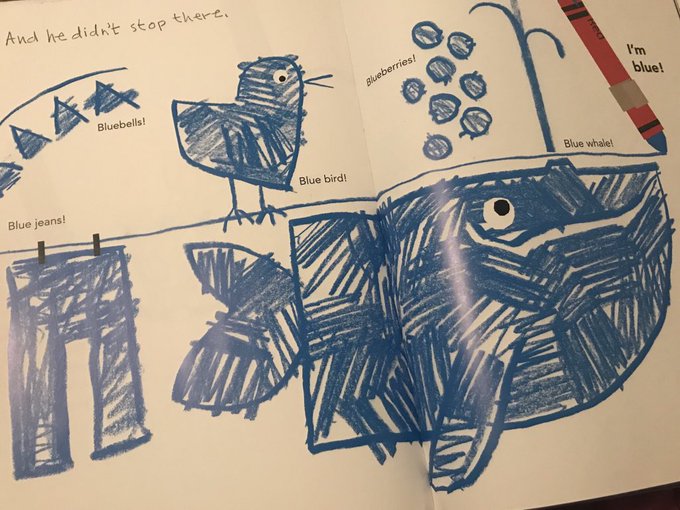
For the younger grades, a non-human example you could use in your classroom is “Red: A Crayon’s Story”. The backgrounds of the illustrations alternate from black to white and back to black. Until, Red meets a crayon who accepts him as blue. Then, all backgrounds change to white (with the exception of one where all of the crayon’s are talking about him again).

This book is all about perspective, which is also what judgement is about. Everyone, including Red, views himself as unable to do anything right. When a new crayon comes along and puts a new perspective on things, other people’s minds begin to change as well. Instead of asking Red to draw strawberries or hearts, his new friend asks for him to complete her picture by drawing a blue ocean for her boat. Red is hesitant, but with encouragement from the other crayon he draws a wonderful ocean.

Another nice touch that Michael Hall added to his book was the end pages. The first end page is red, representing what everyone “wanted” Red to be. And the last end page is blue, representing what he actually is.

For your younger students, this book is an excellent example of how to highlight other’s strengths and encourage them to be themselves.

Michael Hall has dyslexia, and he wrote this story because it relates to how he felt early on when he found out he had it- like he couldn’t do anything right that he was asked to do, especially in school. You can read his statement here: https://www.michaelhallstudio.com/pages/books/crayon/authors-statement.html

Hall, M. (2015). Red: A Crayon’s Story. New York, NY: HarperCollins Publishers.

Last Stop on Market Street

First let me just say that this book BLEW ME AWAY. It is clear to me why this book won the Newberry Medal and the Caldecott Honor.

I recommend this book for any classroom, but really 2nd + because of the background knowledge needed (i.e. younger students may not know what a soup kitchen is).

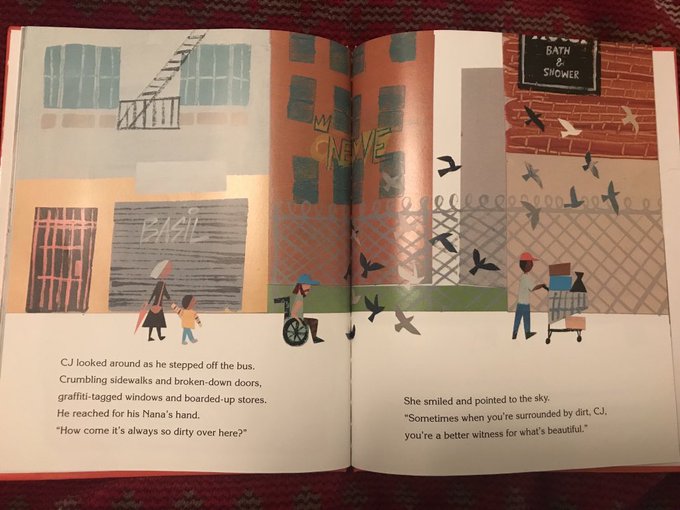
The pictures were wonderfully made by Christian Robinson. He used acrylic paint, collage, and digital manipulation. I Love how colorful the pictures are, and how C.J. and his Nana look small against the city background.

All along the way, CJ is complaining about things such as the rain, and how his Nana doesn’t have a car. His Nana, however, always finds something positive to say back to him. The quote above is my favorite quote that she said in response to him.

My favorite thing about this book is the ending. While reading, the reader may be thinking that CJ and his Nana are on their way to the soup kitchen to eat. However, in the end, the reader sees that they are there to volunteer and help others. This book forces the reader to check his/her unconscious biases for this very reason. After church, CJ and his Nana ride the bus to a different side of town where there is graffiti and barbed wire. CJ asks why they always have to go after church on Sundays, and the reader may think that they routinely get a meal after church. It isn’t until the very end that it is clear that the two characters are there to serve others. Even this is not explicitly stated, but the reader can tell because it is apparent in the illustrations. Both CJ and his Nana are wearing hairnets and can be seen passing bowls.

This book would an excellent one to use in your classroom, especially from a critical literacy standpoint. Children need to see minority characters participating in different scenarios so that they do not come to form the biases of today’s adults that result in judgement.

An activity that could be done in a classroom with this book is patterned partner reading. For this activity, students get into pairs and read the book together, stopping after every page. Before flipping to the next, they either

  • Read- Pause -Predict
  • Read- Pause – Discuss
  • Read- Pause- Make Connections
  • Read- Pause – Sketch
  • Read- Pause – Bookmark
  • Read- Pause- Retell

For the purposes of critical literacy, I think it would be most beneficial to have students do one of the first three with this book. The first three bullets address critical literacy because students would have to address their biases while predicting, discussing, or making connections. (Strategy comes from: McLaughlin, M. & DeVoogd, G.I.. (2004). Critical Literacy: Enhancing students’ comprehension of text. New York, NY: Scholastic. )

De La Pena, M. (2015). Last Stop on Market Street. New York, NY: Penguin Group LLC.

Rescue and Jessica: A Life-Changing Friendship

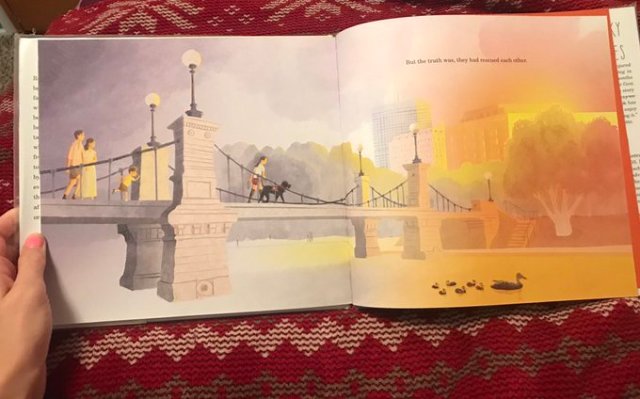
You don’t see a lot of books in the classroom that contain characters who have disabilities. That being said- this book does. Jessica has to eventually have both of her feet, and lower legs, amputated. She is learning how to walk again at the same time that Rescue is training to become a service dog. This book tells the story of how they met and ended up saving each other.

“But the truth was, they had rescued each other.”

There is an author’s note in the back of the book that explains NEADS, a nonprofit organization in Princeton, Massachusetts that works to place service dogs with owners who need them. In addition to the author’s note, there are acknowledgements that contain a picture of Jessica Kensky and Patrick Downes and Rescue! That’s right! Jessica and Patrick are #ownvoices authors! Both of them were injured in the Boston Marathon Bombing that occurred on April 15, 2013, resulting in both of them becoming amputees. Jessica lost both legs and Patrick lost one. Rescue is their black Labrador Retriever and he is very much a part of their family.

Patrick, Jessica, and Rescue.

Downes, P. & Kensky, J. (2018). Rescue and Jessica: A Life-Changing Friendship. Somerville, Massachusetts: Candlewick Press.

Books On Immigration: A Text Set

This text set contains the following books:

  • Her Right Foot by Dave Eggers
  • My Two Blankets By Irena Kobald & Illustrated by Freya Blackwood
  • Wishtree by Katherine Applegate

The first two books listed above are picture books, and the last book is a short chapter book with a little over 200 pages. It, too, contains a few pictures.

Her Right Foot

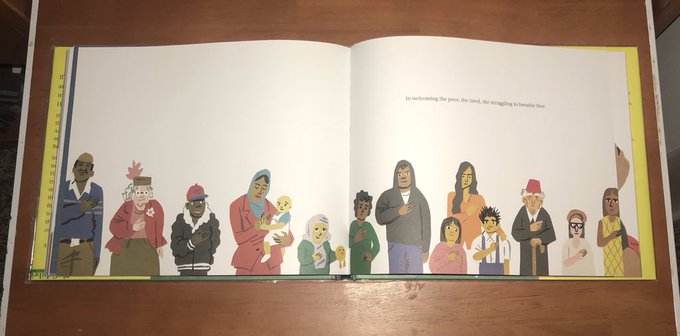
“In welcoming the poor, the tired, the struggling to breathe free.”

Her Right Foot is a children’s book about the Statue of Liberty. The book opens with the history of the statue. The book talks about who created it, and where it came from (France). About halfway through the book, the author brings up that nobody ever talks about the right foot of the statue. And how it’s mid-stride. The statue is moving. The statue is moving because the statue herself is an immigrant.

The picture above showcases a spread from that book. Viewing this spread from a critical lens, I see that the spread is very inclusive. Different races and ethnicities are present, as are people with varying physical traits, such as height and age. The one thing that I don’t see included in this spread is a person with a disability. But I do like that various other populations are shown and I love the added touch of everyone having their hands over their hearts. The illustrations are beautifully done and they showcase defining features of the different parties.

With everything going on in the world, this book relates to current events. Immigration law is often in the news and there are lots of differing opinions on the matter. There are people who are unaccepting of refugees or immigrants coming into America and this is a good book to remind students that they should be tolerant and welcoming to all.

Eggers, D. (2017). Her Right Foot. San Francisco, CA : Chronicle Books LLC.

My Two Blankets

I loved this book and believe that it is a must have for your classroom library. I love the point of view that the author writes from. A child flees her country with her aunt and comes to a new country. She is surrounded by people who speak a language that she doesn’t understand. She retreats home and feels safe under her “blanket” (her native language). She meets a friendly girl in the park and she slowly helps her understand the new language. Soon, the girl starts weaving a “new blanket” (the new language). The book is a wonderful metaphor that has a deeper meaning. The girl now has two blankets and two languages that she feels safe and apart of.

Irena Kobald is an #ownvoices author. She got the idea for the story through an experience that happened in her own life when her daughter and a Sudanese child became friends. Irena herself is an Austrian immigrant who moved to Australia.

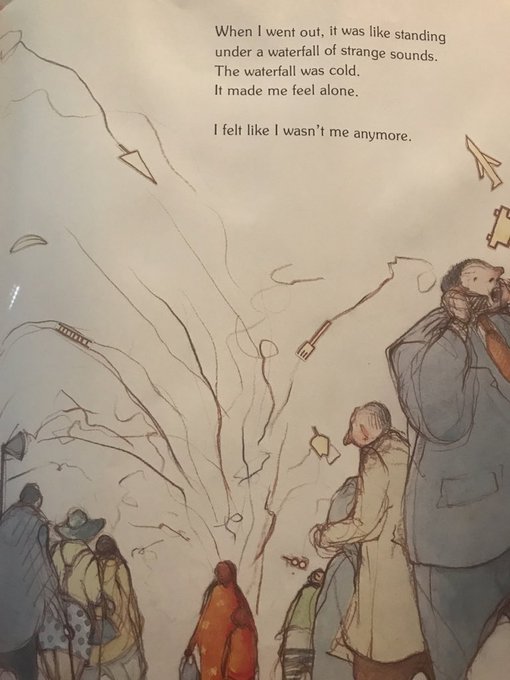
Something I noticed while reading was that the main character and her aunt are colored bright orange. The backgrounds in the book are light, duller colors, resulting in an obvious contrast. I think Freya Blackwood did this to symbolize how the character felt when she was out in public. Maybe she felt like she stuck out or that she didn’t fit in or belong with the crowd.

” It made me feel alone.”

In this particular text, the child from the playground had the power to make choices for a better world. Her first decision was to smile at the main character. She chose to be friendly to someone who may not have felt welcome. Eventually, she goes on to help the main character learn some of her language. Her choice to befriend the immigrant child was a choice to better the world.

Kobald, I. ( 2014). My Two Blankets. New York, NY : Little Hare Books.

Wishtree

Wishtree is a short chapter book. The story is told from the tree’s perspective. The tree’s name is Red. Having 216 rings, Red has seen a lot, but he had never felt like he had done much. One day, he decides to help make Samar’s wish come true, her wish for a friend. With the help of other animals, and RED, Samar forms a friendship with her neighbor, Stephen.

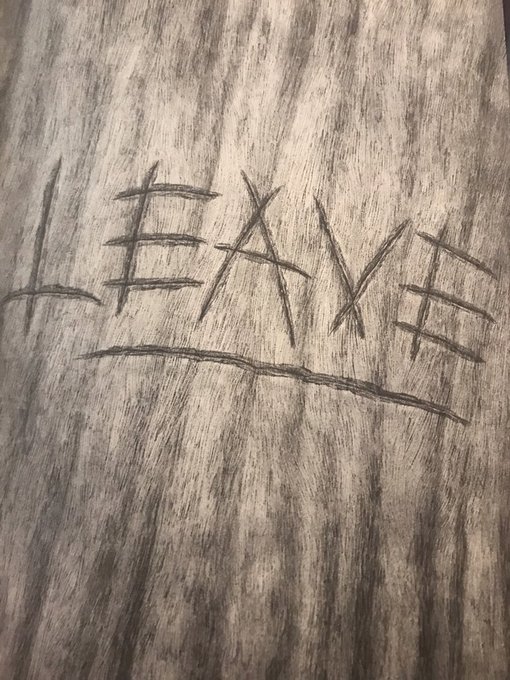
Samar is an immigrant, and one day a rotten little boy carves the word “leave” into Red, who sits in her backyard.

At the end of the story, Stephen organizes their classmates to write “stay” on pieces of paper and hang them from Red. This scenario sends the sociopolitical message that people can band together to combat hate. The message “leave” affected Samar and her family a lot, but all of the other community members who wrote “stay” affected the family more. While you can’t undo what another person has done, you can certainly try your best to make that person feel loved and cared for.

In this book, Stephen and his family are privileged. In the beginning, he understands that Samar is treated differently. It is mentioned in the book that his family doesn’t even converse or interact with Samar’s. Stephen himself doesn’t engage in conversation with Samar, until Red brings them together.

Applegate, K. (2017). Wishtree. New York, NY : Macmillan Publishing Group.

Final Thoughts

Her Right Foot, My Two Blankets, and Wishtree would make a good text set to have in your classroom on the topic of immigration and acceptance. Neither book goes guns blazing on the topic, but rather each treads lightly and delicately addresses it. These books would be an awesome way to bring up the topic in your classroom and open it up for discussion amongst your students.

The Wild Robot & The Girl and The Wolf

Both “The Wild Robot” and “The Girl and The Wolf” share similar themes. While “The Wild Robot” is a longer and more dense story, its central theme is courage. “The Girl and The Wolf” shares the same theme of courage. Both stories contain a character that chooses to be brave. In Peter Brown’s story, it’s the robot, and in Katherena Vermette’s story, it is the girl.

The Wild Robot

In this story, a robot ends up on an island. Her name is Roz and she is accidentally activated by a bunch of curious otters. She does not know where she is or how she got there, only that she must learn in order to survive. The setting is essential to the book because, throughout the story, Roz learns of new animals on the island and how they can all help each other live more comfortably and safely. Additionally, when the climax of the story takes place, the island’s landscape proves helpful in fighting off the other robots.

While the story may seem about survival, since the topic is mentioned on multiple occasions throughout the book, I think the main message conveyed is that you should always be friendly and nice to everyone. In the beginning, Roz is judged and labeled as a monster. Through her various encounters with other animals, she proves to be a very kind and gentle robot. The other animals realize that their judgements were wrong and they come to befriend the robot.

I think that this message can easily relate to the world because humans are so quick to judge others. Often, we misjudge others and therefore miss out on valuable friendships. This book shows the importance of acceptance and openness to others that are different. Originally, Roz was called a monster because she did not resemble an animal that should be on the island. She didn’t belong. But, overtime, the other animals saw her uniqueness and, later, did not want her to leave the island.

I think that this book would make an excellent read aloud for many reasons.

  1. The chapters are short – this would make it easy to fit into a tight schedule, and a chapter or two could be easily read at the end of the day or between transitions.
  2. The book contains a character that students can root for- this was one of my qualities for a good children’s book. Roz is a likable character and one that students can maybe relate to themselves, therefore, they are able to resonate with Roz and root for her.
  3. The theme of courage and message of friendship- sometimes kids need to be reminded to be brave and kind. This book shows the positive outcomes of both.

Brown, P. (2016). The wild robot. New York: Little, Brown and Company.

The Girl and The Wolf

To start off, the author of this book is a #ownvoices author. This means that she is a member of the community that she is writing about. Katherena Vermette is a writer from Treaty One territory in Winnipeg.

In her book, “The Girl and The Wolf”, the wolf is friendly. Generally, the wolf is not-so friendly. Examples of “bad” wolves can be found in many stories such as “Little Red Riding Hood” and “The Three Little Pigs”. In the author’s note at the back of the book, she mentions that she found that the wolf was always the villain when reading European fairy tales. She thought that this was unfair, and thus created a story where the wolf was helpful and guiding.

In her story, a little girl is warned by her mother to stay close. Unknowingly, the little girl wonders off away from her mother and becomes frightened once she realizes that she has gotten lost. A wolf appears and he helps her find the courage to stay calm and find her way back.

The setting is essential to this book because the little girl gets lost in the woods, and that is how she meets the wolf.

At the end of the story, the little girl thanks the wolf by wrapping tobacco in a piece of red cloth.

Vermette, K. (2019). The girl and the wolf. Canada: Theytus Books.

Introducing Myself: Who Am I?

I am a recent graduate of Appalachian State University. Currently I hold a BS in Elementary Education. Additionally, I am pursuing my MA in Reading Education, also at Appalachian State University.

I am twenty-two years old, and recently engaged. I enjoy anything and everything outdoors. I’ve always gone skiing with my mom every year, since I was little. I like to play soccer and I also kayak and hike when I have the opportunity.

I have four siblings, three brothers and a sister. I am the second youngest child, with the eldest being 31 and the youngest 15.

On this blog I plan to discuss:

  • connections between various children’s literature books
  • themes of different children’s books
  • activities that could be completed using children’s books
  • other pedagogical topics related to children’s literature

Through reading this blog, I hope that it encourages deep thought and consideration of the books that are used in the classroom. I hope that maybe you also find a little inspiration for your own (if you have one) !

Design a site like this with WordPress.com
Get started