I’m continuing to discover the power of mentor texts and how they can help students in the classroom. This week, I read Jabari Jumps by Gaia Cornwall. Using this book, I worked with some peers to create a short lesson that aids students in identifying writing topics. We focussed on hand maps. For this activity, students trace their hand and assign each finger an emotion. Branching off from those fingers are instances where the student felt that particular emotion. These memories become writing ideas. To read through the lesson I designed, use the following link: https://docs.google.com/document/d/1c7gRPhfrmhwN6jAaxk8LLdcjU3uUXcSs2jpftD-2Boc/edit?usp=sharing
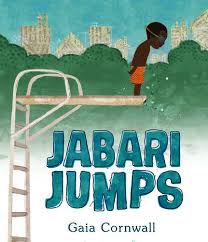
Jabari Jumps is a good mentor text because Jabari experiences lots of emotions in this story. One could argue that he experiences excitement and fear, to name a few. Additionally, this book is about a small moment, which is what students are encouraged to write about, rather than writing a story about everything that happened in one day.
Before creating the lesson, and the hand map, I tried my hand at writing a small story. I was visiting my grandparents this past weekend, and so my small moment story was inspired by my grandma.
The Special Box
I’ve always loved visiting grandma’s, partly for all of the cliche reasons, like eating junk food and getting to do whatever I want, but also because of the tan Romeo and Juliet cigar box.
Upon my family’s arrival, usually after dinner, my sister and I would watch as my grandma got up from the table, and made her way over to the hutch in the corner of the room. We’d inch up on our heels and sit taller, our lips curled up to form a smile as we saw grandma reach for the box, all the while wondering what special gift would be inside of it this time. There was never any way of telling. Sometimes it’d contain handmade jewelry, other times acrylic paints and craft paper. All we knew was that the box held something special inside, something that grandma had picked out just for us.
What we liked about grandma’s gifts was that we each always got something different. She wasn’t afraid to get us different things, unlike our other relatives, who always gave us the same gift, but in different colors. Aly would always get green, and I would get the same exact toy or sweater, but in light blue.
We always treasured grandma’s gifts because they were thoughtful. Everything great we knew came from our grandma’s heart, and her cigar box.
I wrote about a super small moment that had special meaning to me. If/when sharing with students, I might omit “cigar box” and just use the word “box”, in effort to make the story more school appropriate.
I didn’t find it hard at all to write about this moment. Once I started, the memory washed over me and I was able to keep writing about that moment.
Students may have trouble if you simply instruct them to write about a small moment. The hand map serves as a way for students to brainstorm small moments that they associate with various emotions, hopefully solving the, “I don’t know what to write about” problem.
The most important goal is that children write. Once they have written their short story draft, it can be revisited later and revised. According to Dorfman and Cappelli, the use of dialogue is an important element of stories (p. 80). The authors even pose the example from the children’s book Happy Like Soccer by Maribeth Boelts. In this book, dialogue helps the reader understand the relationship between Sierra and her aunt, and even Sierra and her coach. Perhaps students could be encouraged to embellish their story by adding some dialogue.
Basically, there are lots of ways to improve upon writing, and sometimes I wonder if a piece can ever really be “done”. However, there is no wrong way to write. Just make time for your students to do so.
Boelts, M. Happy Like Soccer. (2012). Somerville, MA: Candlewick Press.
Cornwall, G. Jabari Jumps. (2017). Somerville, MA: Candlewick Press.
Dorfman, L. & Cappelli, R. (2017). Mentor Texts: Teaching writing through children’s literature, k-6 (second edition). Portland, ME: Strenhouse Publishers.
 Children's Literature Blog