Alex Gino’s book, George, opened my eyes to how much we, as people, assume gender through our use of certain words. This book brought many words, that I even use with my students, to my attention. For some time, I have never thought to realize how these words might negatively affect another person. For example, the use of “boys and girls” when addressing the class, handing out a “boys” or “girls” bathroom pass, and using words like “Mr.” and “Ms”. Specifically, when my students have a question, I call on them and say things such as “Yes sir?” or “Ma’am?”. From my perspective, I thought that I was modeling respect for my students and addressing them in ways that would build trust and mutual regard. This book showed me an alternate perspective that I had not considered. And, honestly, I’m a little disappointed in myself because I always try to be conscientious of the feelings of others.
Discovering Their Identity: Using Gender Nonconforming Picture Books in Early Education Classrooms, provides information of why you should have these types of books available, and also the challenges that come with it. Evans, Gilbert, and Doyle (2017), claim that children establish their gender identity by age five. Since they have established their gender identity, they need a safe place to develop this identity further. Schools and classrooms can be that place, socially. The three challenges that the authors discuss are :
- availability
- quality
- teacher use
To tackle availability, the authors suggest having these books in your classroom and also providing a list of books to parents for them to have at home. In order to evaluate quality, teachers should “provide books that reflect young children’s identities and portray a range of cultures, immigration statuses, genders, socioeconomic statuses, sexual orientations, and family structures (Evans et al., 2017). Lastly, teacher use is a challenge because teachers should support every student. Since gender identity is a controversial subject in today’s society, few teachers are willing to discuss it. Personally, I understand the fear of criticism from higher ups or parents, but, how can you possibly please everyone? You will do kids a disservice if you ignore the topic when it might play a very large part of their life, like it did Melissa’s, in George.
I think that George raises awareness of the subtlety of gendered language in our society. I really enjoyed the book, mainly because I’ve never read one like it. While I do like the book, I would be a little concerned about using it in my classroom, because Melissa’s anatomy is brought up on more than one occasion. I worry about the appropriateness of the book for a classroom for this reason, not because gender identity is discussed.
While I’m a little apprehensive of using it in my classroom, I do love the themes. This book touches on many themes. This list is a few I identified:
- Be who you are. (A theme the author put on the back of the book.)
- Always support your friends, you never know how they may be feeling.
- Be accepting of others.
- Don’t be afraid to challenge something you don’t believe in.
- Persevere and you will succeed.
For more information on teaching discussing gender identity, and for two suggested picture books, click here: http://www2.ncte.org/blog/2019/10/discussing-gender-binary-topics-elementary-students/
The website above taught me something that I did not know about books on gender identity: “school administrators often prohibit librarians from using school funds in order to purchase books on these topics for their students”.
While I do think making your classroom a safe and inclusive place should be a top priority, I think that we, as a society, are still figuring out how to do this without ruffling feathers and stepping on so many toes. Although I am hopeful, I don’t know if that will ever be a reality. Even if it is not, teachers still have a responsibility to be critical and help their students become empowered citizens.
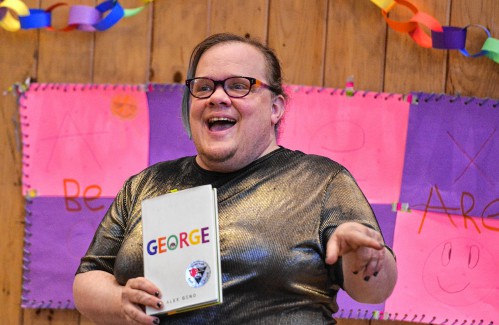
Gino, A. (2015). George. New York, NY: Scholastic Inc.
Doyle, T., Evans, S., & Gilbert, S. (2017). Discovering Their Idenitity: Using gender nonconforming picture books in early education classrooms. Literacy Today.
 Children's Literature Blog