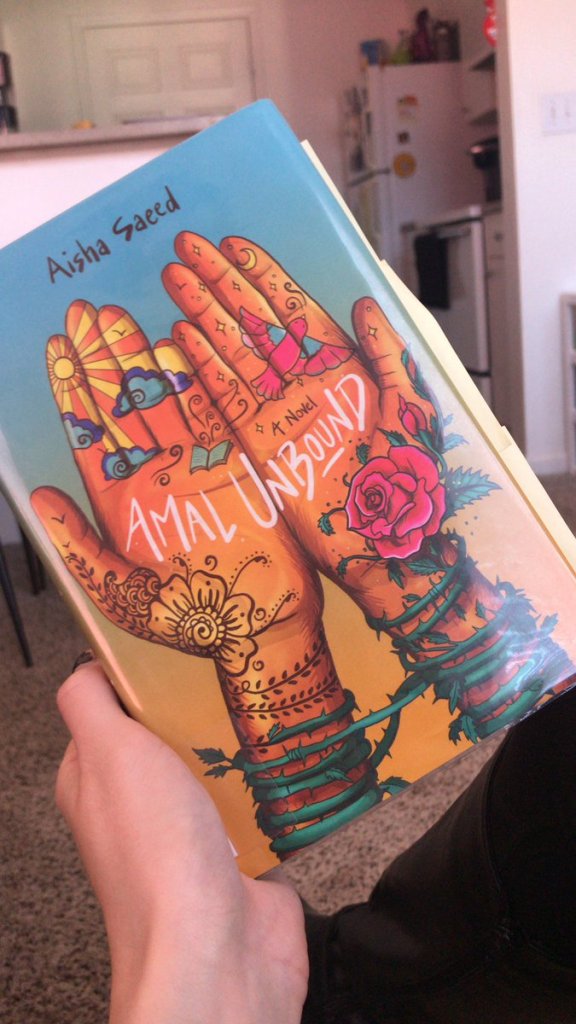
This past week, I read Amal Unbound, by Aisha Saeed, and Iqbal, A Brave Boy From Pakistan / Malala, A Brave Girl From Pakistan, by Jeanette Winter.
First off, Amal Unbound was awesome!!!! I loved the story and the theme about the importance of sticking up for yourself and pushing back against injustice. I admired the complex character that was Amal, a young woman who valued education and questioned gender roles. She enjoys school and learning, and she hopes to become a teacher someday. When her mom has another baby, her family needs her to stay home from school and help around the house. Amal’s father is adamant that she stays home to assist. Amal questions this and wonders if she would be allowed to go to school if she were a boy. She speculates that, since she is a girl, she is expected to stay home to cook, clean, and take care of her younger siblings.
Lots of existential topics were present throughout the story, some of which were:
- the unfairness of life
- the meaning of freedom
- is it better to forgive than to hold onto animosity?
- being appreciative of what you have when you have it
- can one person make a change?
This book is about a young girl who overcomes her situation in order to find her way back home.
My favorite quote from the book comes from page 207. It reads:
“If everyone decided that nothing could change, nothing ever would.”
Jeanette Winter’s book is also about young activists, both Malala and Iqbal see an injustice and do something about it. Both speak out about their cause. Malala’s cause is women having the right to an education, and Iqbal’s is about child labor.
Winter’s book contains two stories. The front cover of the book starts Malala’s story, and the reverse side starts Iqbal’s story. In the middle of the book, is the illustration below.
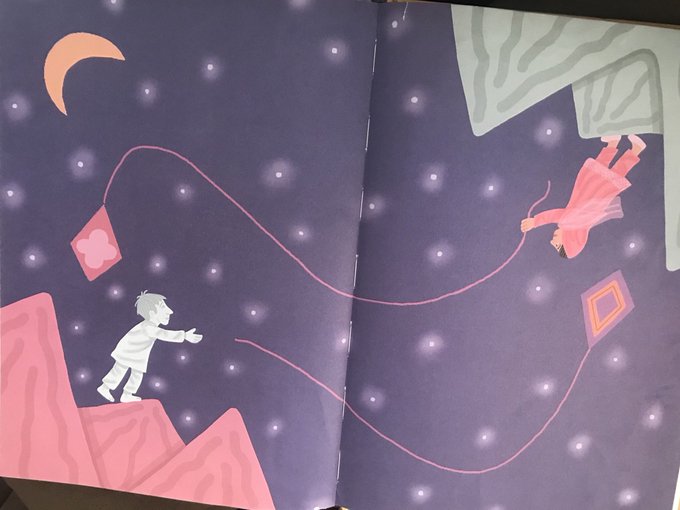
This picture struck me because Iqbal is grey, and he has let go of his kite. Malala is in color, and she is still holding onto a kite. I’m speculating that Iqbal may be grey because he has passed. In his efforts to speak out against child labor, he was shot and killed when he was twelve. Malala was shot while speaking out for her cause, but she survived. I’m wondering if maybe Iqbal has released his kite because he is no longer on Earth, able to fight for his cause. Malala is alive and still fighting for her cause (the kite). Maybe the kite is a symbol. Both Malala and Iqbal have kites, although different. Just like both had causes, though different. While they fought for different things, they both fought back for the rights of children. I wonder about the significance of the mountains that they are standing on. The mountains are the color of the other child. Malala is standing on grey mountains and Iqbal on pink mountains.
To view Malala’s story, click here: https://www.youtube.com/watch?v=CXvs1vwiD0M
To read about current child labor issues, click here: https://www.hrw.org/topic/childrens-rights/child-labor#
Before each story, there is a short backstory along with the quote, “Let us not pray to be sheltered from dangers, but to be fearless when facing them.” I love that Winter chose to include this quote because I think it speaks volumes. As human beings, we should not be ignorant to what is going on around us, even if it is negative. While there is a lot of bad in the world, we can combat it by speaking out or fighting back. In doing so, we should be brave.
Both of these books would motivate students to take a stand against injustice. Both books feature characters that are young in age, and therefore relatable to students. Laminack and Kelly claim that children see injustice more easily and more clearly than many adults do and that they’re more likely to become upset with situations they deem “unfair” (p. 84). These stories show that you don’t have to be an adult to make a difference, kids have powerful voices that should be heard too
Saeed, A. (2018). Amal Unbound. New York, NY: Nancy Paulsen Books.
Winter, J. (2014). Malala/ Iqbal: Two Stories of Bravery. New York, NY: Beach Lane Books.
Laminack, L. & Kelly, K. (2019). Reading to Make a Difference: Using Literature to Help Students Speak Freely, Think Deeply, and Take Action. Portsmouth, NH: Heinemann.
 Children's Literature Blog