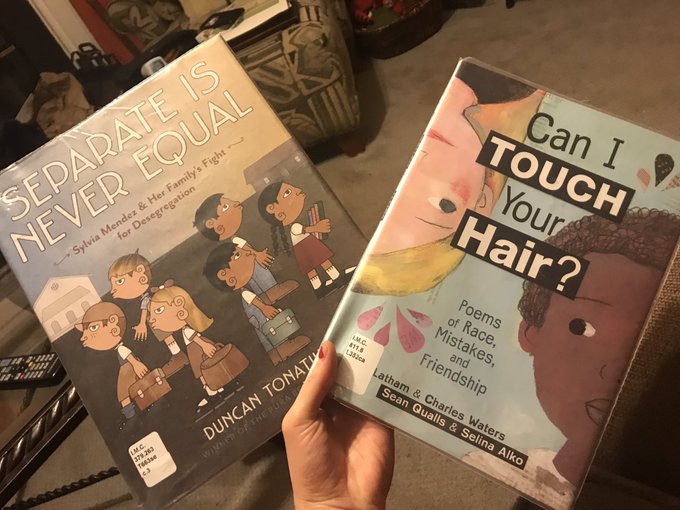
Separate Is Never Equal by Duncan Tonatiuh
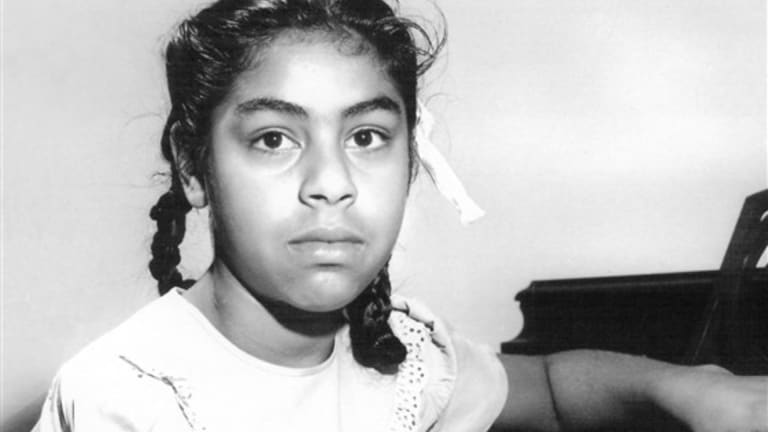
Separate is Never Equal: Slyvia Mendez & Her Family’s Fight for Desegregation is about the Mendez vs. Westminster School District trial, in which Mandez’s family argued that their children had a right to go to Westminster School. Slyvia was told that she had to go to the “Mexican School”, which had fewer resources, no playground, and outdated/tattered books. Ultimately, Mandez’s family was sided with, even after an appeal by the school district. You can read more about the case here: https://www.uscourts.gov/educational-resources/educational-activities/background-mendez-v-westminster-re-enactment
There are two pictures from this book that I would like to point out. First, the picture on page 13 (created by the author, Duncan Tonatiuh).
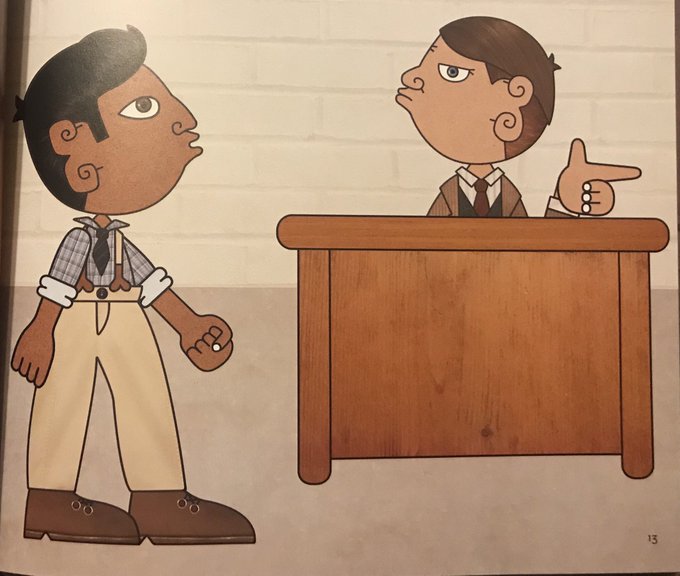
In this photo, Mr. Mandez can be seen talking with a school representative. The person behind the desk has a scowl on his face and he does not look like he is happy talking with Mr. Mendez. He tells Mr. Mendez that his children must go to the “Mexican School”, but offers no explanation as to why. This is racism because the school representative views Mr. Mendez’s children as inferior because they are Hispanic, and he is discriminating against them by forcing them to attend a school that is not as “good” as Westminster. Mr. Mendez combats this racism because, although he is told his children must attend the other school, he continues to fight for their right to attend Westminster. He tries to get others to sign a petition, but he eventually takes his case to court. I love this illustration because Mr. Mendez’s left hand is clenched in a fist, showing that he still has power.
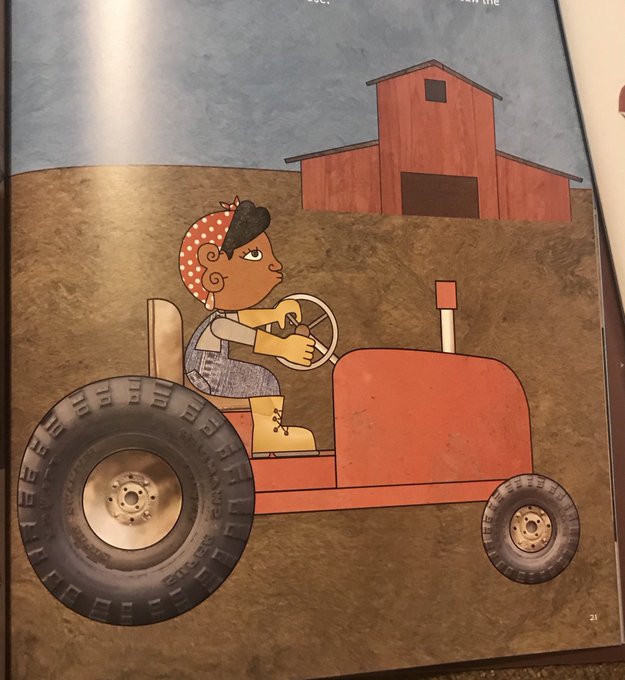
The photo above comes from page 21. Mrs. Mendez can be seen on a tractor. While Mr. Mendez was working on getting his children into Westminster, she was at home taking care of their family farm. In addition, she got her kids ready for school and continued to take care of them everyday. I think that this illustration shows Mrs. Mendez in power because she is shown as a strong women who can handle taking care of her kids and working on the land. She is in overalls and work boots, and she is also operating machinery. She is combating the job stereotype of “maid” or “nanny”, as is often seen in movies (such as The Pacifier (2005), Maid In Manhattan (2002), and The Nanny (1993-1999) ).
Tonatiuh, D. (2014). Separate is Never Equal: Sylvia Mendez & Her Family’s Fight for Desegregation. New York, NY: ABRAMS Books.
Can I Touch Your Hair by Irene Latham & Charles Waters
This book, full of insightful poems, paints two different perspectives: those of an African American boy and a Caucasian girl.
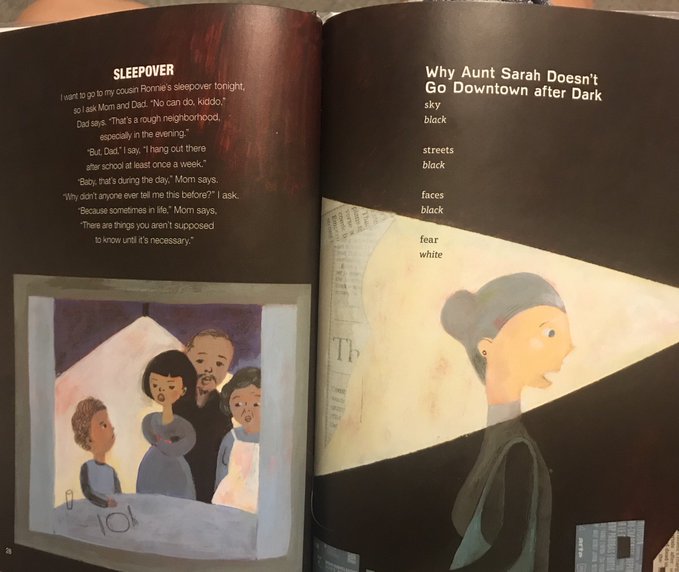
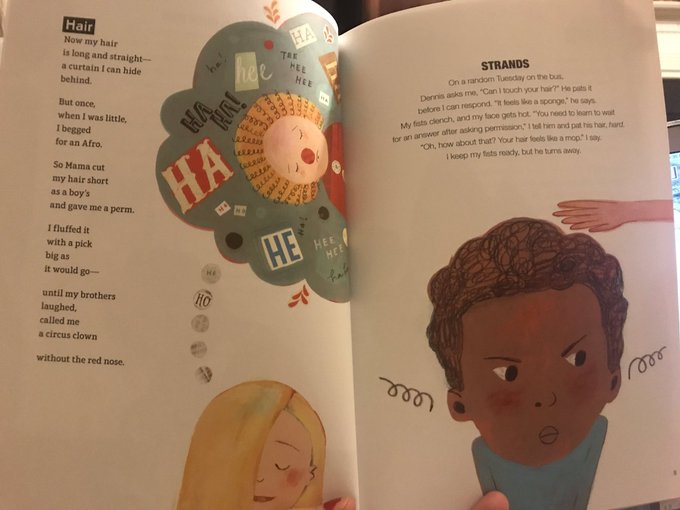
The book starts with poems from each character, explaining their feelings about being partners for a writing assignment at school. Later, the two children show their differing viewpoints on topics such as hair, church, the beach, and dinner with their families.
Latham and Waters do a great job of showcasing the characters’ points of view. Something that makes topics such as these more personal.
Poetry has always been so powerful and profound, in my opinion. Therefore, it seems only right that difficult conversations, such as stereotypes and judgement (see “Strands” on page 9 and “Why Aunt Sarah Doesn’t Go Downtown After Dark” on page 29, my two personal favorites.) can happen as a result of this genre of literature.
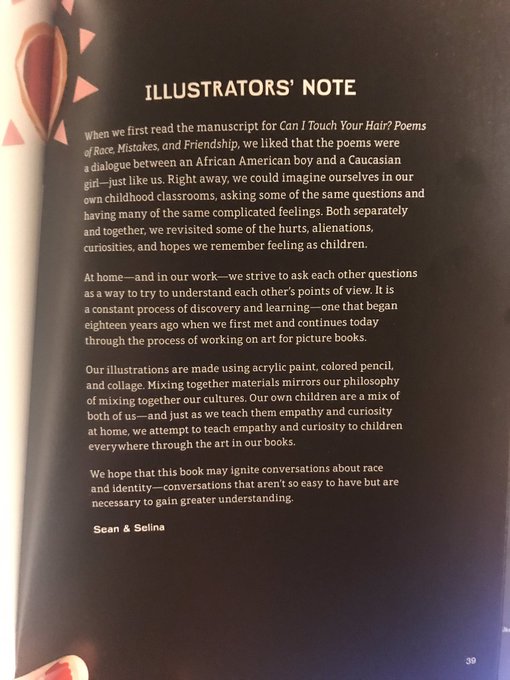
The illustrators, Sean Qualls and Selina Aiko, used acrylic paint, collage, and colored pencils to create the beautiful illustrations. I especially liked how the facial expressions on the various characters (like the two children, “Ghost” aka Paul, and the teacher) were created to reflect their feelings at that given time. These illustrators have such talent!
The poems, told from a child’s perspective, could be really powerful to share with other children. In doing so, children may begin to second guess, or think twice, before they participate in certain actions (like saying, “Can I touch your hair?”). Children are never too young to start learning how to treat all people like people.
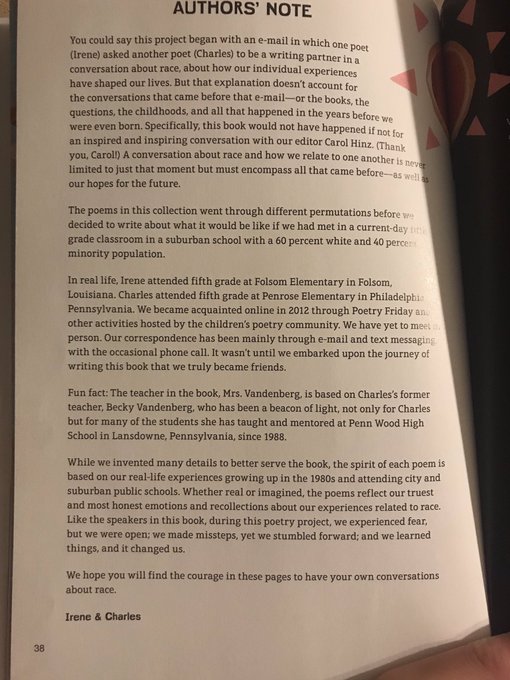
I thought the authors’ and illustrators’ notes were very perceptive. I took a picture of them and will insert them below.
Latham, I. & Waters, C. (2018). Can I Touch Your Hair? : Poems of Race, Mistakes, and Friendship. Minneapolis, MN: Carolrhoda Books.
 Children's Literature Blog